

Against the grain
Niagara Sawmilling Company has operated in Invercargill since 1935. It currently processes more than 160,000 cubic metres of timber annually, with drying capacity exceeding 260,000 cubic metres. Now it is spending $115 million on a brownfield modernisation that will install an entirely new sawline, AI-driven optimisation systems, and an industrial IoT platform designed to squeeze more usable timber from every log that enters the facility.
The investment runs directly counter to the industry’s dominant logic. Approximately 62% of all New Zealand roundwood is exported in raw form rather than processed domestically. That ratio has barely shifted in a decade. Most forest owners look at the spot log export price, compare it to the cost of domestic processing, and ship the wood offshore. Niagara is betting the other way.
The technology is the thesis
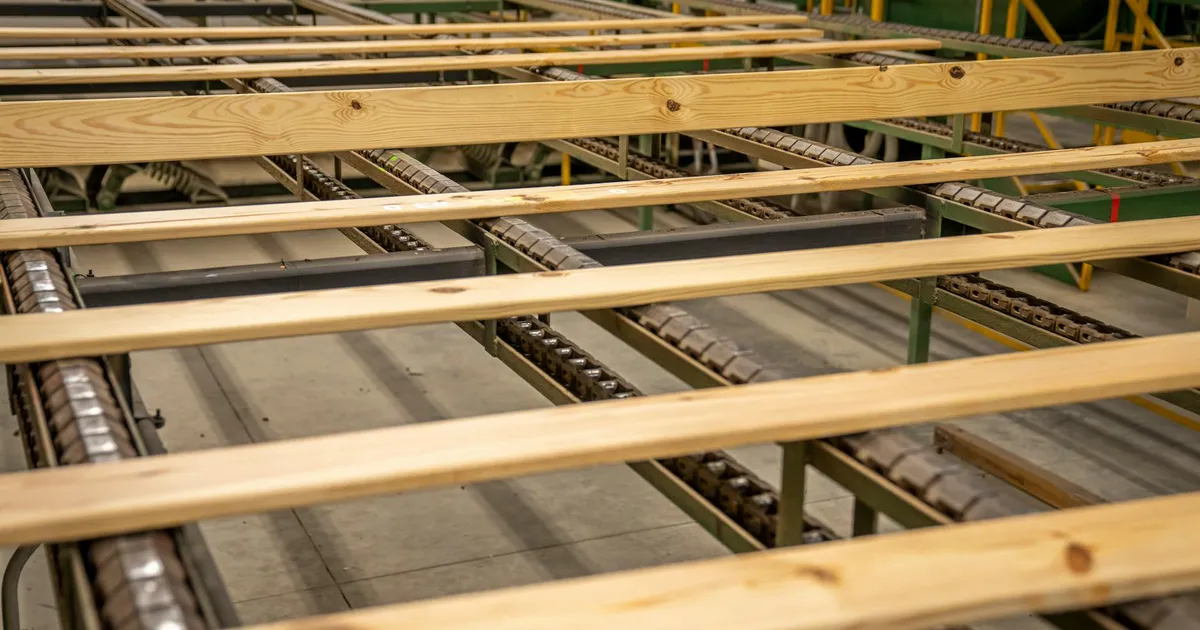
This is not a cosmetic upgrade. The new installation, delivered by Canadian equipment supplier Comact with local engineering from Lakeland Steel, includes a Hybrid Sawline combining triple profiling with circular saws and a 7-foot bandsaw, plus an AI-powered TrimExpert optimizer for fibre recovery and Smart Vision systems for real-time quality monitoring. The entire operation feeds into Comact’s OPER8 industrial IoT platform for continuous performance management.
For a mill running 160,000-plus cubic metres per year, even a few percentage points of improved fibre recovery translates to meaningful revenue uplift. That’s the mechanism by which Niagara expects to make domestic processing economics work against cheaper offshore competition.
Ross Richardson, CEO of Niagara, said the investment would “significantly enhance reliability, efficiency, and fiber optimization” across operations. Equipment delivery is scheduled for late 2026, with commissioning planned for 2027.
The industry wants this to work
Niagara’s bet aligns with a broader push from the Wood Processors and Manufacturers Association, which has a formal plan to double the value of exported timber to $11.5 billion by 2034, up from $5.75 billion in 2024. At the 2025 WPMA Conference, Forestry Minister Todd McClay cited a 27% rise in processed wood exports to $1.1 billion in the past year.
Wayne Mulligan, CEO of NZ Bio Forestry, argued that “forestry needs to change how it sells, treating forests as feedstock for higher-value, low-emissions products rather than bulk log suppliers.” That is exactly what Niagara’s investment embodies.
There are tailwinds. India FTA negotiations are progressing toward phased tariff reductions on processed timber. Mass timber construction is gaining traction domestically, with projects at Parliament and in Tauranga demonstrating commercial viability. And Niagara’s kiln complex runs entirely on wood residues, insulating it from the energy cost pressure that hammers other manufacturers.
The honest headwinds
But the market is not crying out for more capacity right now. Sawn timber production peaked at 4.64 million cubic metres in 2017 and declined to 4.14 million cubic metres in 2024. Stock levels sat at 543,190 cubic metres as at December 2024, elevated relative to 2021 levels of 452,420 cubic metres. The domestic market is not undersupplied.
For Niagara’s payback to work over a decade-plus horizon, it needs some combination of stronger construction demand, improved export market access, and the per-unit cost advantage its technology is designed to deliver. Two of those three are outside the company’s control.
Southland is collecting big bets
Niagara’s expansion adds to a growing Southland investment pipeline. The $3.5 billion Datagrid data centre project received full resource consent and plans to land a subsea cable from Australia at Oreti Beach. The two projects represent different models of regional economic development, but both signal that Southland is actively competing for large-scale capital.
Niagara has one advantage the data centre does not: 90 years of operating history, an existing workforce, and proven demand for its product. It is not a speculative greenfield play. It is a mature business doubling down on the thesis that processing timber in New Zealand, rather than shipping it raw, can still generate returns that justify serious capital.
Whether that thesis holds will not be clear until commissioning in 2027 and the years that follow. But in an economy where manufacturing investment is rare and regional capital even rarer, $115 million on the table deserves more attention than it has received.
Sources
- Niagara Sawmilling Company Selects Comact for Major Modernization Project in Invercargill, New Zealand (2025-12-09)
- Niagara Sawmilling Company to modernize New Zealand sawmilling operations with new sawline and AI-powered systems (2025-12-09)
- New Zealand’s Niagara Sawmilling Modernizes With Comact (2025-12-09)
- Wood industry unveils value-added plan to double exports (2025)
- Let’s Build Here, Export More – The Case for Higher-Value NZ Timber (2025)
- Sawn timber production in New Zealand
- Stock levels of sawn timber in New Zealand
- Wood processing | Canopy
- From dairy to data, the $3.5 billion bet on Southland (2026-03-16)