

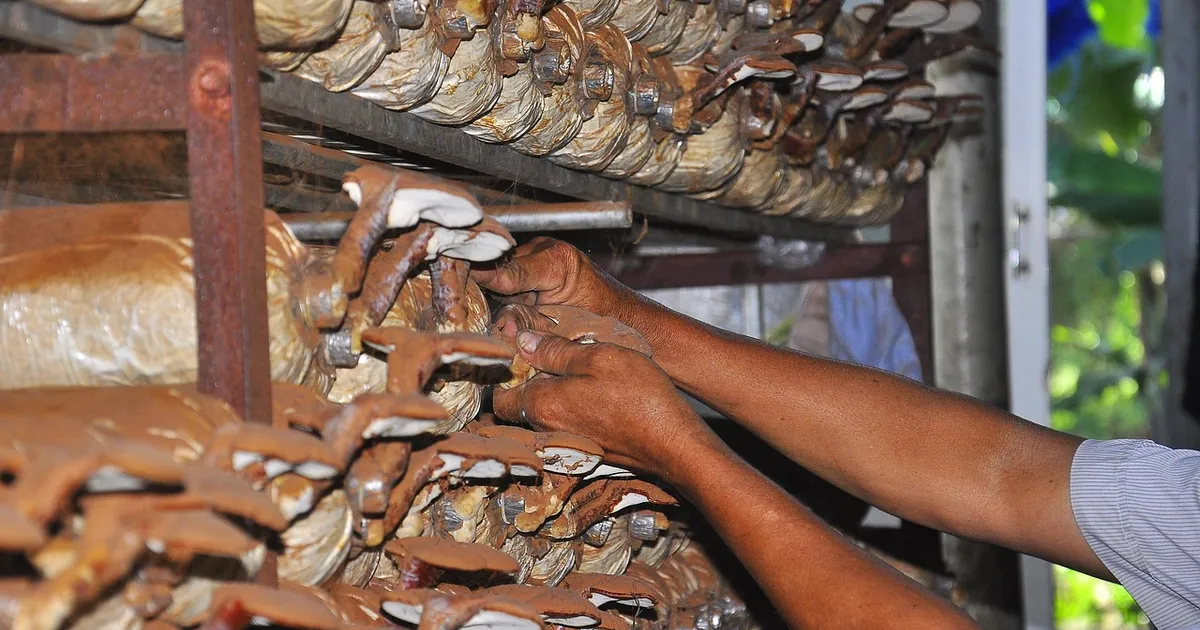
Every week, more than 7 million mushrooms and over 170 tonnes leave Meadow Mushrooms’ Hornby operation in Canterbury. Every one of them is picked by hand. In an age of automated milking sheds and robotic apple packers, that sounds like a business that has fallen behind. It isn’t. It is a business that has done the maths on automation at New Zealand scale, and the maths currently favours people.
That is the uncomfortable productivity lesson for a lot of Kiwi food producers. The technology exists. The market is too small to make it pay.
Four or five mushrooms at a time
Meadow runs 72 identical Dutch-style growing rooms with around 400 staff, most of them harvesters. They ride semi-automated lorries through the growing corridors, picking four to five mushrooms at a time at 40-50kg an hour. Executive chair Miranda Burdon told RNZ’s Country Life the harvesters “not only grade, they quality control incredibly fast”, because every box needs consistently sized product. Her verdict on automation is blunt: there is “no robot that we would replace them with.”
Some rough arithmetic shows what is at stake. At 45kg an hour, 170 tonnes a week implies roughly 3,800 picker-hours every week. That is a large, permanent wage bill, and Meadow has chosen to mechanise around the picker rather than replace them. In 2018 the company said it had invested about $100 million moving from wooden trays to shelf-based Dutch systems, when it was picking 4.5 million mushrooms a week with almost 600 staff.
The headline numbers since then are not a clean growth story. In 2023, Selwyn Libraries reported the farm producing over 9 million mushrooms and 200 tonnes a week with around 500 staff. Today’s figures are lower on both counts, which may reflect product mix, different counting methods or a genuine trim. What does hold up is output per worker, which on those figures sits at roughly 400-425kg per staff member a week, flat to slightly better. Capital spent on shelving and trolleys has kept people productive without removing them.
An industry already squeezed to three
Meadow’s choices make more sense against the wreckage around it. At the 2024 Trans-Tasman Mushroom Growers Conference, then-chair Geoff Martin said New Zealand had 13 commercial mushroom farms in 2001 and was down to around three. He listed the pressures as input and energy costs, a weak farm gate return and “issues with labour for picking, getting people to actually work in our industry.”
United Fresh’s 2025 data shows how concentrated what remains has become. The three largest commercial growers have annual capacity of 10,000, 3,000 and 390 tonnes, in a sector worth $76.13 million in 2023. Exports in the year to June 2024 were a trivial 48.7 tonnes. Imports are not the threat. Cost structure is.
And labour is the biggest piece. Stats NZ data for mushroom and vegetable growing shows mean quarterly earnings rising from $9,120 in 2013 to $15,600 in 2024, a lift of about 71% in a decade, well ahead of inflation.
The robots work, the volumes don’t
This is where it gets interesting. Overseas, robotic harvesting is no longer science fiction. Mycionics founder Ryan McCartney says farm trials have delivered around 15% labour efficiency gains from early automation and up to 75% labour reduction on harvest platforms using four-arm robotic pickers. He puts loaded labour costs at close to AUD$50 an hour in Australia once insurance, benefits and supervision are counted.
Australia grew about 1,200 tonnes a week in 2024. New Zealand’s entire industry grew roughly 250 tonnes. That gap matters. PwC’s new Future of Food report warns that agricultural robotics costing around NZ$1 million for relatively specialised applications can be difficult to justify at New Zealand scale, and that technology has to solve a genuine economic problem before it earns its place.
Put simply, a robot that pays back across hundreds of growing rooms in Ontario or the Netherlands takes far longer to pay back across 72 rooms in Hornby, especially when each machine has to match a human who grades and quality-checks in the same motion.
What this means beyond mushrooms
The mushroom sector is a sharp case study for any New Zealand producer running a labour-heavy line: horticulture, meat processing, seafood, packhouses. Scale has done a lot of the work. Consolidation from 13 farms to three created operators big enough to justify Dutch growing systems and mechanised logistics. But scale in a five-million-person market still tops out well short of the volumes that make frontier automation pencil out.
That leaves two pressure points to watch. One is labour supply, because a business needing thousands of picker-hours a week is exposed to every tightening of immigration settings or the regional job market. The other is the price curve of robotics. If the per-unit cost falls meaningfully, the Hornby calculation flips quickly, and the producers already operating at scale will be first to switch.
Until then, Meadow’s approach is the rational one. Spend capital where it lifts output per worker, keep the skilled hands, and let the overseas giants pay the early-adopter premium on the robots.
Sources
- RNZ: Country Life – The massive mushroom operation feeding Kiwi consumers (2026-11-28)
- NZ Herald: Miranda Burdon claims Family Business award (2018)
- RNZ: Trans-Tasman conference – Growers ponder ways to make mushrooms more appealing (2024-10-24)
- United Fresh: Fresh Facts 2025 (2025-10-28)
- Figure.NZ / Stats NZ: Linked Employer-Employee Dataset, LEED measures by industry (2026-02-26)
- Mycionics: Should you automate mushroom farming? (2026-04-09)
- PwC: Future of Food – A New Zealand perspective (2026-11-11)
Join the discussion
Add useful context, ask a good question, or challenge an idea — keep it specific and respectful.