

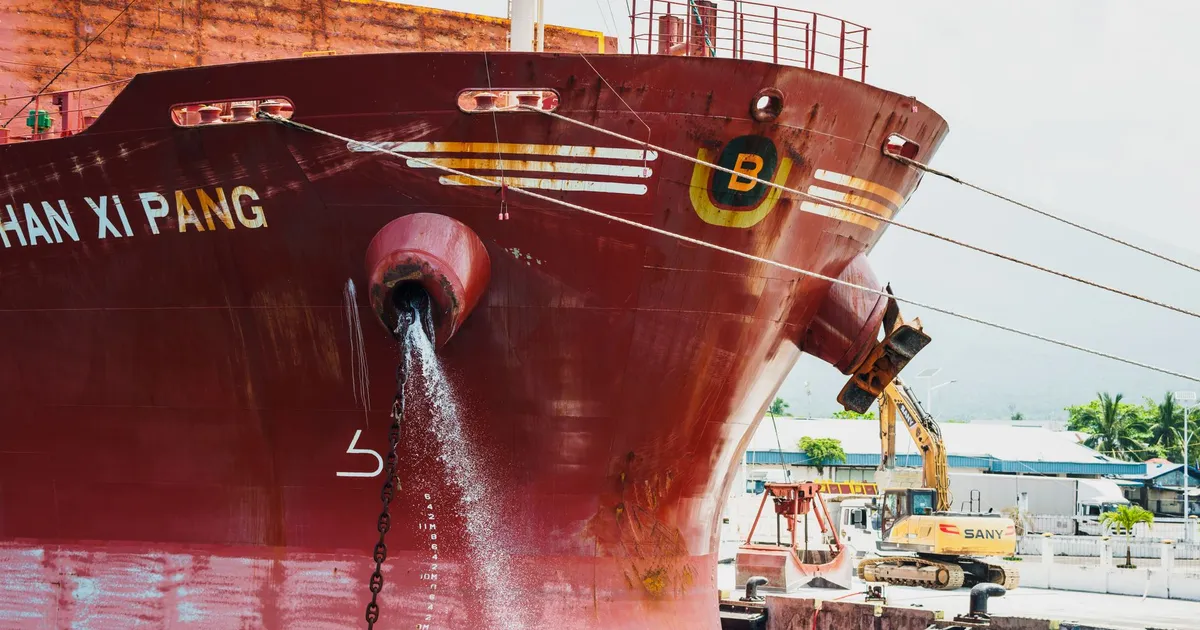
Three crew members were injured when the composite boiler aboard the Malta-flagged bulk carrier Olivia exploded at South Port, Bluff, on 24 May 2025. The Transport Accident Investigation Commission’s final report, released today, does identify mechanical faults. But its real finding is that the controls meant to stop tired people making bad calls had quietly fallen away. This was a management failure before it was an engineering one.
A five-day stop that never ended
The 20,928-tonne Olivia, technically managed by Fleet Management Limited of Hong Kong, berthed in Bluff on 23 April 2025 for what was supposed to be a five-day port stay. Engine and generator problems on the inbound voyage meant Maritime New Zealand required repairs before departure, and a visiting technician found every generator needed extensive refurbishment. A short stop became an open-ended repair programme.
The engineering crew split into day and night shifts to cope. Anyone who has run a plant shutdown knows what happens next. The schedule stretches, the plan written for week one is still nominally in force in week four, and the gap between the roster and reality widens.
The phone call that decided it
On 23 May the boiler’s burner failed, followed by repeated unsuccessful reignition attempts and a blowback. The next day, with no senior engineering officer rostered overnight to authorise higher-risk work, the night shift third engineer rang the chief engineer. The chief later told investigators he had been “in deep sleep and very tired”.
He misunderstood the job, believing it was limited to cleaning the burner nozzle and diffuser plate rather than the whole boiler. Crew then sprayed inside a boiler that had not properly cooled after the failed ignitions, without face or eye protection. It exploded.
The broken parts were the small story
TAIC found the boiler likely flamed out and would not restart because of a malfunctioning air-intake flap, a faulty ignition transformer and soot buildup. Those are ordinary faults on any ageing vessel. What turned them into an injury event was organisational.
Senior engineering officers were working beyond their recorded 12-hour shifts, with some evidence of crew working outside defined hours altogether. TAIC concluded it was “very likely” that fatigue adversely affected decision-making, and flagged two safety issues: weak implementation of the vessel’s safety management system and a lack of guidance for managing crew through sustained, intensive work.
Chief investigator Louise Cook puts it bluntly. “Long repair programmes need continuing attention to workloads, rest and supervision. If an unexpected job is beyond people’s capability, it should be a straightforward decision to stop and get the right support.”
Same task, different hazard
The crew had cleaned this boiler before, but always cold, at sea, after several days of cooling. TAIC’s own messaging on the case makes the point that familiar work becomes higher risk in different conditions. A furnace that had just blown back and was still hot was a materially different job, yet nobody reassessed it as one. The missing eye and face protection tells you the crew saw it as routine.
This is the failure mode that generic risk assessments invite. The paperwork covers “clean boiler”. It does not cover “clean boiler an hour after it misfired, at 3am, on week five of an unplanned repair, with the only person authorised to say no half-asleep on the phone”.
Why every shutdown manager should read this
Strip out the ship and this is any extended maintenance programme in manufacturing, food processing, energy, ports, forestry or heavy transport. Shift limits exist on paper. A safety management system exists in a binder. Neither executes itself. They work only if someone with authority is awake, properly briefed and willing to halt the job when conditions change.
Nor is this a one-off. An industry analysis from the Chartered Institute of Logistics and Transport argues that fatigue, communication breakdowns and missed controls keep recurring across recent New Zealand transport investigations, regardless of operator or vessel type. The pattern points to culture and systems, not individual carelessness.
Fix it before the report lands
TAIC issued no new recommendations, because Fleet Management had already reviewed its procedures, protective equipment and fleet-wide training during the investigation. That is the right response, and credit is due. It still took three injured crew and an 18-month inquiry to get there.
For directors and operations leaders, the practical questions are simple. When a planned job turns open-ended, who re-rosters supervision? What triggers a fresh risk assessment when conditions change? And does the night shift actually have someone senior, rested and on site who can say stop? If the honest answers rely on tired people getting it right every time, the next incident report is already being written.
Sources
- Stuff: Fatigue and safety failures contributed to Bluff ship boiler explosion, injured three (2026-10-30)
- RNZ: Fatigued crew sprayed boat boiler that hadn’t cooled before explosion – TAIC (2026-10-30)
- TAIC: Crew injury on bulk carrier, M.V. Olivia, South Port, Bluff, 24 May 2025 (2026-10-30)
- The Press: Fatigued crew sprayed boat boiler hadn’t cooled before explosion – TAIC (2026-10-30)
- TAIC News: When familiar work becomes higher risk (2026-10-30)
- CILT: What recent transport investigations reveal about safety culture
Join the discussion
Add useful context, ask a good question, or challenge an idea — keep it specific and respectful.