

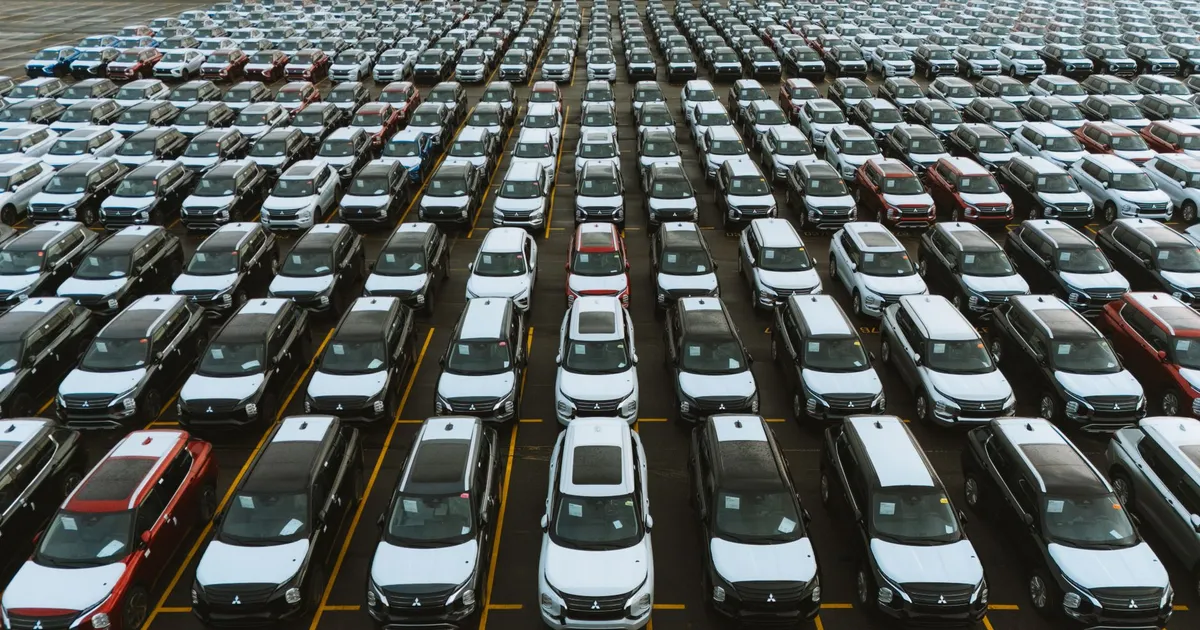
Petrol vehicles in New Zealand are losing value faster than the same-age models did ten years ago. Hybrids and diesels are holding firm. For fleet managers, that changes the maths on every replacement cycle, every lease and every finance arrangement built on an assumed residual.
The finding comes from Trade Me data comparing like-for-like age cohorts from 2016 and 2026, reported by RNZ this week. Trade Me calls it “a market-wide trend for petrol, not a specific impact on older vehicles”, with petrol models seeing “softer price retention than they did 10 years ago, while hybrids and diesels are holding their ground.” The same report notes battery and plug-in hybrid vehicles made up 25.2% of new light vehicle registrations in September, up from 9.1% a year earlier. That near-tripling in demand is what is pushing petrol down the queue.
The new car price is doing the damage
This is not a mandate story. It is a pricing story. The AA’s Terry Collins puts it bluntly: Teslas that once cost $76,000 to $78,000 now sell for “$60,000-something”, and “the sharp prices and discounting for brand new ones drives down the second-hand market.” His wider point should worry anyone holding a yard of three-year-old petrol utes and hatchbacks: “If you’ve only got to spend a few extra grand or $10,000 extra to get a new car, why would you spend a lot on a secondhand one?”
Collins expects big V8s and thirsty six-cylinders to fall hardest. Diesel is holding partly because so many diesel buyers are commercial operators with their own resale dynamics, which is cold comfort if your fleet is mostly petrol sedans and SUVs.
The notable thing for a centre-right reader is that the market is getting there on its own. Nobody in Wellington is forcing this. Buyers are responding to cheaper new EVs and expensive fuel, which is exactly how price signals are supposed to work.
A $30,000 EV resets the whole ladder
The next shove is already landing. BYD’s Atto 1 is entering New Zealand at roughly $30,000, and that matters because of how this country’s used market has always worked. Used imports made up 42% of the light fleet in 2023, and 97% of used passenger-car imports came from Japan in 2025. For decades we have effectively imported Japan’s depreciation curve.
University of Auckland senior lecturer Dr Kenny Ching spells out the problem: “If a three-year-old petrol car costs $27,000 while a comparable new car costs $40,000, buying used may make sense. But if a credible new EV costs as little as $30,000, that calculation changes.” He calls it “a structural change in our vehicle market”, not a routine swing in brand share. When the bottom rung of the new market drops to used-import prices, every rung below it gets squeezed.
Book value is not market value
Here is where finance teams need to pay attention. In 2025, the Budget’s Investment Boost scheme sweetened write-offs on new assets. Under the worked example published in June 2025, a $100,000 vehicle carried a year-one book value of $63,200 on straight-line or $56,000 on diminishing value.
Those are tax numbers. They say nothing about what a buyer on Trade Me will pay in year four. A business that bought a new petrol vehicle for the tax deduction has captured the deduction, but it still owns the resale risk. If the market curve falls faster than the schedule, the loss shows up on disposal, and it compounds across a fleet.
The regulatory framework was not built for this. IRD’s 2018 kilometre-rate statement set running-cost rates of 26 cents per km for petrol and diesel, 18 cents for hybrids and 9 cents for electric. Even then, the running-cost gap was visible. The resale gap is now joining it.
An old fleet means a lot of exposure
New Zealand is unusually exposed. Back in 2018, the Ministry of Transport’s fleet report found the average light vehicle was 14.1 years old, older than in the US or Australia, with 98.8% of the fleet running on petrol or diesel. That is a lot of owners, lenders and leasing firms holding the same depreciating asset at once.
In April 2026, Newsroom contributor Mike Casey warned of a coming “big game of petrol car hot potato” within five years. The Trade Me numbers suggest the game may have started early.
What fleet buyers should do now
Stop treating residuals as a fixed assumption. Stress-test replacement plans against a steeper petrol curve, shorten hold periods on the most exposed models, and price total cost of ownership with realistic disposal values, not last decade’s. Diesel utes for genuine work use still look defensible. A petrol sedan pool bought on autopilot does not.
The businesses that get caught will not be the ones that bought the wrong car. They will be the ones that assumed the car would be worth what it used to be.
Sources
- RNZ: Why your car might be losing value faster than it used to (2026-10-29)
- RNZ: Cheap Chinese EVs could soon shake up NZ’s used car market. Are we ready? (2026-10-06)
- University of Auckland: Cheap EVs could reshape used car market (2026-10-12)
- NZ Herald: Ute buyers face Investment Boost carrot, Fringe Benefit Tax ‘stick’ (2025-06-18)
- IRD: OS 18/01 Commissioner’s statement on using a kilometre rate for business running of a motor vehicle (2018-07-04)
- Ministry of Transport: The NZ Vehicle Fleet Report 2018 (2018)
- Rewiring Aotearoa: Hot potato, hot potato! Depreciation has been a barrier to EV uptake, but the risk could soon shift to ICE cars (2026-04-15)
Join the discussion
Add useful context, ask a good question, or challenge an idea — keep it specific and respectful.