

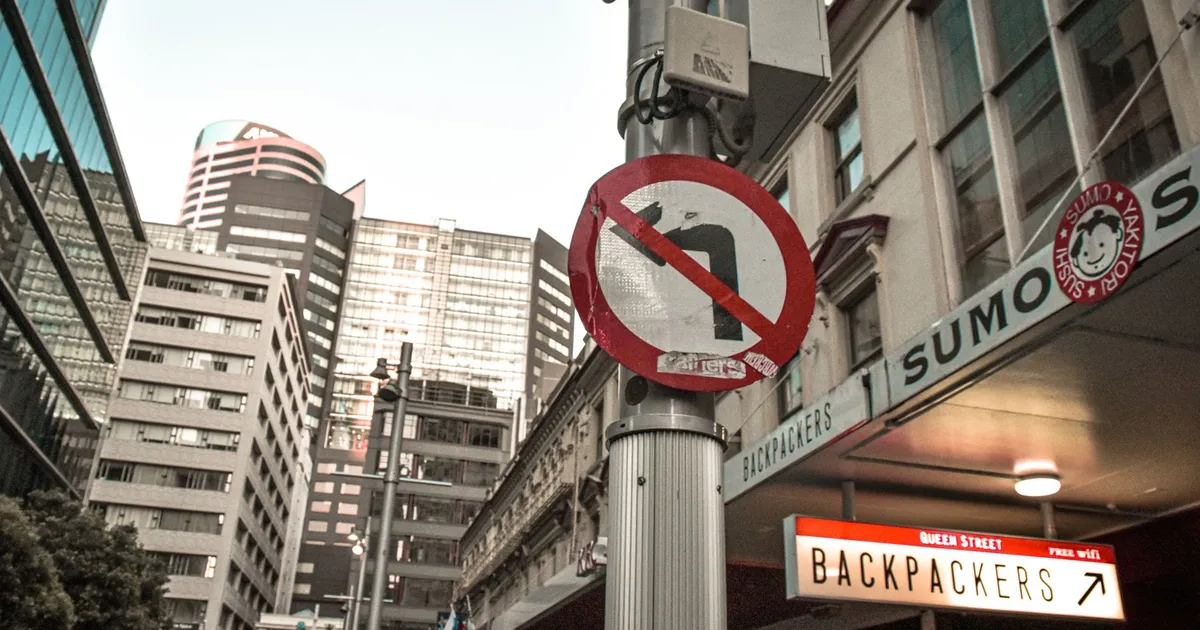
Prada shuts its Queen Street doors on Wednesday, ending more than a decade in a two-storey, roughly 350 square metre store. It will be read as a verdict on Auckland’s central city. It mostly isn’t. The luxury precinct at the bottom of the street is doing fine. The problem is everything above it, and the data meant to tell landlords and retailers how bad that problem is cannot agree with itself.
A store that was making money
The detail most coverage skates past is that Prada’s local subsidiary posted an increased profit of $257,891 for the year to 31 December 2025. This was not a store bleeding out.
Retail consultant Chris Wilkinson of First Retail Group called the exit “especially unusual” given other luxury brands are expanding nearby, and suspects Prada is repositioning for a different site. Retail NZ chief executive Carolyn Young floated volatile exchange rates, freight costs or simply a decision not to renew a ten-year lease. Infometrics chief forecaster Gareth Kiernan put it bluntly: “Auckland isn’t seen as enough of a growth market compared to other opportunities internationally.”
That is a global portfolio call, not a street-level collapse. Simplicity chief economist Shamubeel Eaqub notes the aspiring middle classes have pulled back on luxury worldwide while the ultra-wealthy keep spending. Wilkinson expects the site, next door to Dior, to be snapped up quickly. He is probably right.
Two streets with one name
Kiernan describes the lower Queen Street luxury strip as “like another world”, insulated from the construction disruption and drift away from physical retail that has hit the street further up. The numbers back him. In 2025, Colliers reported that strong demand persisted for premises in the luxury and international brands precinct, with prime rents rising through late 2024.
The rest of the street is a different conversation. Back in 2023, RNZ counted 172 vacant CBD shops, more than 50 of them in arcades off Queen Street. Young, speaking at the time, described the cascade every landlord fears: a few empty units thin out foot traffic, the remaining tenants leave, and the vacancies compound.
Foot traffic is the core issue. A Knowledge Auckland paper published in December 2024 found city centre pedestrian counts over the two years to October 2024 were still 26 percent below pre-Covid levels. Premium rents need premium footfall, and for most of the street it has not come back.
Nobody can agree on the vacancy rate
Here is where it gets uncomfortable for anyone signing a lease. In 2025, Colliers put Auckland CBD strip retail vacancy at 11.0 percent in June 2025, up from 10.0 percent a year earlier. JLL’s mid-2025 report put CBD retail vacancy at a much lower 7.5 percent in the second quarter, and falling.
Different methodologies and boundaries explain some of the gap, but a three-and-a-half point spread is not a rounding error. One reading says the CBD is softening; the other says it is tightening. JLL also put CBD prime net rent at $2,575 per square metre a year, forecast to hold until late 2026. Holding rents with rising vacancy is a combination that does not last.
Spending is not riding to the rescue
The consumer backdrop is flat. Stats NZ’s September card data showed core retail spending up just 0.1 percent year-on-year, with apparel down more than 5 percent. Nor is this uniquely Auckland. Christchurch’s central city recorded card spending of $1.25 billion in the year to June 2025, down 3 percent, with shoppers cutting back on dining and higher-end retail. Developers noticed: in 2025 Colliers reported Auckland retail building consents had fallen to the lowest level in more than 30 years.
The catalysts have to deliver this time
The optimists have genuine ammunition. The City Rail Link drew 500,000 visitors in its first month, and Britomart’s redevelopment and the new cruise terminal are real. But Queen Street has been told for years that the turnaround is just around the corner.
For business, the takeaway is simple. Treat lower Queen Street and the rest of the street as separate markets. Do not price mid-street space off luxury-precinct sentiment. And do not sign long leases on the assumption that the CRL fixes foot traffic until pedestrian counts actually prove it. Prada’s departure is a single tenant making a global call. Whether the CRL can lift footfall above that luxury enclave is the question that decides what Queen Street is worth over the next five years.
Sources
- RNZ: What will Prada closure mean for Queen Street? (2026-10-27)
- The Post: Luxury fashion house Prada calls time on NZ store in ‘unusual’ move (2026-10-21)
- RNZ: Queen Street’s ‘golden mile’ tarnished by retail vacancies (2023-11-18)
- Knowledge Auckland: Auckland’s city centre – good prospects despite recent challenges (2024-12)
- Christchurch City Council: Central City Annual Update, year to 30 June 2025 (2025-06-30)
Join the discussion
Add useful context, ask a good question, or challenge an idea — keep it specific and respectful.