

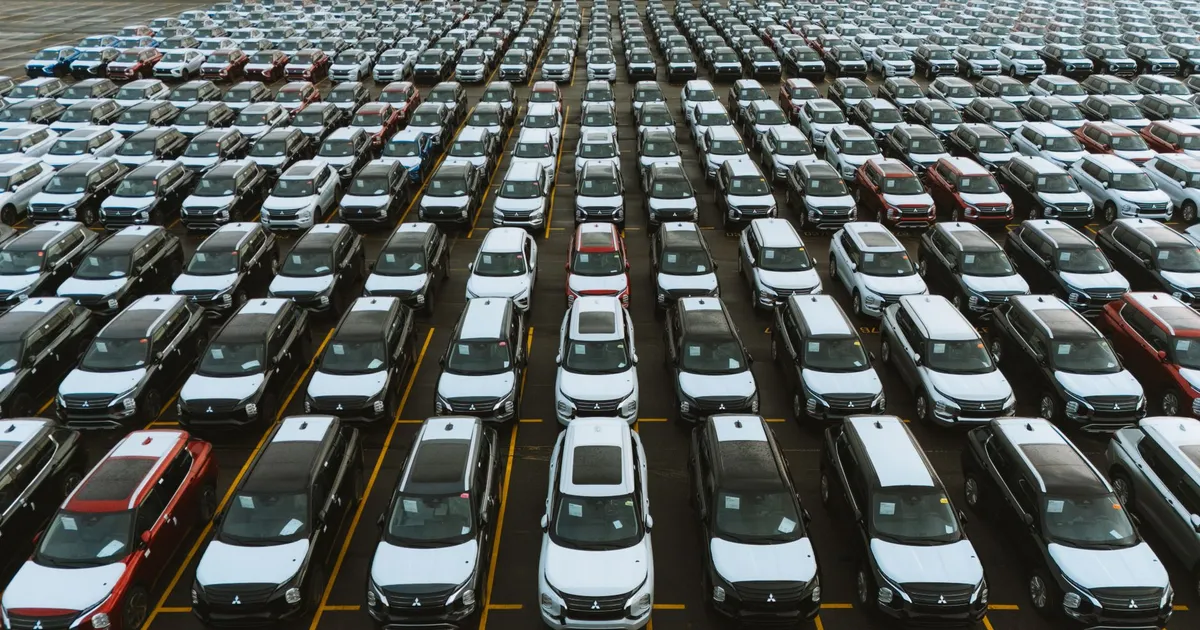
For decades the economics of the New Zealand car yard were simple. Japanese buyers absorbed the steep early depreciation, and Kiwis bought the result five to ten years later at a fraction of the price. That model is now under real pressure, because a credible new car from China costs not much more than a tired used import.
James McDowall, Motor Trade Association head of advocacy, puts it bluntly: “Twenty-five thousand dollars buys a six-year-old RAV4 with 100,000km on it, or a brand new MG with a 10-year warranty.” Once that sentence is true, every price on a used-car lot is up for renegotiation.
Japan’s depreciation was the business model
The dependence is structural. Used imports made up 42% of the existing light-vehicle fleet in 2023, and almost all of them come from Japan. As University of Canterbury economist Kenny Ching argues, new and used are not separate markets. If a three-year-old petrol car costs $27,000 and a comparable new car $40,000, used wins. If a capable new EV costs as little as $30,000, the calculation flips, and the pressure cascades down through every older car on the ladder.
That is no longer hypothetical. The BYD Atto 1 and Dongfeng Box became the first new battery EVs to break below $30,000 in New Zealand, and the Atto 1 carries a five-star safety rating rather than budget-car compromises.
The squeeze is coming from above
China supplied 73% of fully electric vehicle imports in the year to June 2026. Reduced-emission vehicle imports overall rose 33% to $2.9 billion, now 48% of passenger vehicle import value.
The rebound matters because of how weak the base was. In 2025, Stats NZ reported EV import value had fallen 57% to $395 million in the year to June. This is not a gentle trend line. It is cheap Chinese product creating a price point that did not exist two years ago.
Meanwhile the used import pipeline is shrinking and ageing. Used imports contracted 14% in 2025, from 103,925 to 89,188 units. McDowall describes used stock that is older and “being squeezed from above”, and asks whether the import model still stacks up at these prices.
Financiers are holding the residual risk
The least discussed exposure sits with finance companies. Every car loan and lease is priced on an assumption about what the vehicle will be worth at the end. If cheap new EVs compress the price ladder, petrol residuals fall faster than those models assume. Lower residuals also make an expensive gearbox or engine repair harder to justify, which pushes cars to the wrecker earlier and drains demand for parts, fuel and servicing.
Dealers carrying large petrol inventories face the same problem on their own balance sheets. Stock bought at yesterday’s prices may have to clear at tomorrow’s.
Workshops face a slower, deeper shift
The ecosystem at stake is large. MITO’s 2025 report found the wider automotive sector employs more than 68,000 people across about 15,000 businesses, contributing roughly $8 billion to GDP, with repair and maintenance alone accounting for about 23,400 jobs.
EVs still need tyres, suspension and collision repair, so the work does not vanish. But the skills mix shifts toward batteries, power electronics and software. Whether independent workshops can service a fleet of 20-plus Chinese brands depends on access to repair information, and McDowall expects right-to-repair reform is likely coming, though its pace “will depend on who forms the next government”. Workshops should be planning for that now, not after the election.
Buyer caution is buying the trade time
Here is the good news for the sector. Consumers are not yet rushing into used Chinese cars. MTA’s Larry Fallowfield says only 12 percent of used-car buyers are considering a Chinese brand, against 76 percent for Japanese vehicles. EV consideration drops from 30.7 percent among new-car buyers to just 8.2 percent among used buyers, with battery life and resale value fears now the main deterrents.
Japan’s own sluggish EV uptake also limits second-hand supply. Used EVs were just 3% of used passenger imports last year, mostly ageing Nissan Leafs.
On top of that, the Clean Car Importer Standard has proved hard for importers to meet, and any compliance charges risk being passed on as higher prices, a regulatory cost layered onto a market already in flux.
The window will not stay open
None of this is an automotive collapse. The fleet turns over slowly and petrol cars will dominate for years. But the businesses that win will be the ones that use the lag. Dealers should rethink stock mix and pricing assumptions, financiers should stress-test residuals, and workshops should retrain technicians and build Chinese-brand capability before those cars age into the used market. Standardised battery-health reporting, which the MTA is calling for, would unlock the used EV trade faster than any subsidy. The price ladder has already moved. The only question is who adjusts before their margins do it for them.
Sources
- 1News: What a wave of cheap Chinese EVs means for NZ’s used car market (2026-10-08)
- The Conversation: Cheap Chinese EVs could soon shake up NZ’s used car market. Are we ready? (2026-10-05)
- RNZ: Chinese electric vehicles reshaping New Zealand’s car market (2026-08-14)
- RNZ: Sluggish demand for used cars puts brakes on Chinese automakers’ growth (2026-09-11)
- Stats NZ: Electric vehicle imports lose charge as volumes drop (2025-07-22)
- Autotalk: Six-year-old RAV4 or a new MG for the same money – MTA puts the shift to dealers (2026-09-15)
Join the discussion
Add useful context, ask a good question, or challenge an idea — keep it specific and respectful.